The 4-H year runs from October 1st to September 30th
Become a Member or Volunteer
4-H offers youth many different ways to get involved. Some youth participate as members of a traditional 4-H Club, while others enroll as Independent Members and complete projects on their own. Schools and community organizations can also participate in 4-H School Enrichment programs without youth becoming individually enrolled 4-H members.
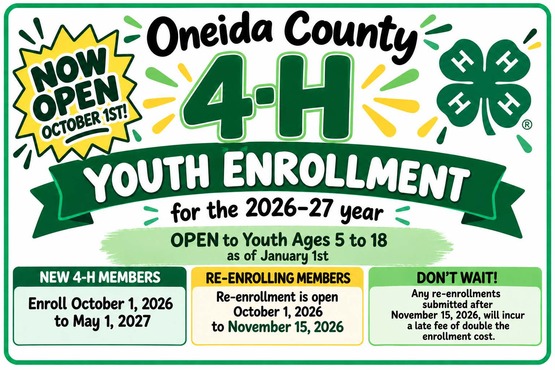
Oneida County 4-H serves youth ages 5–18, with age determined as of January 1 of the current 4-H year.
4-H Members — Ages 8–18
Youth ages 8–18 are considered traditional 4-H Members.
4-H Members can explore project areas that interest them, develop new skills, participate in hands-on learning experiences, and build confidence and leadership skills.
4-H Members typically have access to the full range of 4-H opportunities, including:
- County 4-H programs and events
- Workshops, clinics, and educational activities
- Animal Science and non-animal project areas
- County Fair opportunities
- Competitive contests and events
- Regional and New York State 4-H opportunities
- Leadership and community service opportunities
Eligibility, age divisions, and requirements may vary depending on the individual program or event.
Cloverbuds — Ages 5–7
Youth ages 5–7 are known as 4-H Cloverbuds.
The Cloverbud program focuses on participation, exploration, personal growth, and gaining new experiences rather than competition. Cloverbuds are encouraged to try new things, develop skills, make friends, and experience everything 4-H has to offer in an age-appropriate environment. Cloverbuds may participate in many 4-H programs and activities; however, some programs, contests, animal opportunities, or events may have additional age or eligibility requirements.
All youth, whether a traditional 4-H Member or a Cloverbud, have the option to participate as either an Independent Member or a Club Member. The information below explains the different ways youth and adult volunteers can participate in Oneida County.
4-H Member Enrollment Forms
4-H Member Enrollment (Open October 1st to May 1st)
TYPES OF MEMBERSHIP
Independent 4-H Membership
An independent 4-H member is a youth who is officially enrolled in 4-H but does not belong to a traditional 4-H club. Instead of attending regular club meetings, they work on their 4-H projects more independently, usually with support from a parent, family member, mentor, or the 4-H office.
The biggest difference is how they participate, not what opportunities they have. An independent member can still take part in county, regional, and state 4-H opportunities they are eligible for.
For example, an independent member might:
- Choose their own project areas based on their interests—animals, gardening, photography, cooking, sewing, STEM, woodworking, art, outdoor education, leadership, and much more.
- Learn by doing at home, on a farm, or in the community. A youth interested in dairy cattle might work with their animal throughout the year, while another youth might grow a garden, complete photography projects, or learn to bake.
- Attend 4-H programs and workshops when something interests them rather than attending regular club meetings.
- Complete a Public Presentation or Creative Communications.
- Participate in contests and events such as Dairy Bowl, Livestock Skillathon, Dairy Judging, clinics, fun shows, workshops, or other county and regional programs.
- Complete projects for the County Fair, including animal projects or projects for the Exhibit Hall.
- Participate in the County Fair and potentially the New York State Fair when they meet the requirements for those opportunities.
- Complete their 4-H project work on their own schedule. This can be especially helpful for families who have busy sports, school, farm, or activity schedules.
What could a year look like?
An independent member interested in livestock might enroll in October, attend a livestock workshop during the winter, participate in Skillathon in the spring, work with their animals at home, attend a fitting or showmanship clinic, exhibit at the County Fair in the summer, and finish the year by submitting their project accomplishments for recognition.
Another independent member interested in arts and cooking might learn cake decorating at home, attend a county 4-H cooking program, create a photography project, complete a public presentation or creative communications, enter several projects for County Fair judging, participate in another 4-H event that interests them, and complete their project work without ever needing to join a traditional club.
Independent does not mean doing 4-H alone. It simply means the youth isn't tied to a particular club or regular club meeting schedule. They can still be very active in 4-H and build their own experience around the projects and opportunities that interest them.
For Oneida County especially, this is the path many youth use as an independent membership is a very normal way to participate in our program—especially for families who want the opportunities of 4-H but can't commit to another regular meeting schedule.
Traditional 4-H Club Membership
A traditional 4-H Club is a group of enrolled 4-H youth who meet regularly with an enrolled 4-H Adult Volunteer Leader.
Clubs provide youth with opportunities to learn through hands-on projects, leadership, community service, educational activities, and recreation. Unlike a one-time program or workshop, a traditional club is designed to be an ongoing part of the 4-H experience. Clubs may meet monthly or more frequently depending on the interests of the members and the projects they are completing.
Types of 4-H Clubs
A 4-H Club can be a general club, where members explore a variety of 4-H project areas, or a project-specific club centered around a shared interest.
Project areas could include:
- Animal Science
- Dairy and Livestock
- Horses
- Gardening and Horticulture
- Cooking and Nutrition
- Sewing and Textiles
- Arts and Crafts
- STEM and Engineering
- Environmental Science
- Outdoor Education
- Leadership and Citizenship
- Community Service
- Shooting Sports
- And much more!
One of the strengths of 4-H is its flexibility. Clubs can be designed around the interests of the youth, the skills of the volunteer leaders, and the needs of the community.
Click here for a List of Oneida County Clubs
What Happens at a 4-H Club Meeting?
Every club is a little different, but a traditional meeting may include:
- A short business meeting
- Youth officer reports
- A hands-on project or educational activity
- Planning a community service project
- Preparing for county, regional, or state 4-H opportunities
- Youth presentations or demonstrations
- Recreation, games, snacks, or social activities
As youth gain experience, they are encouraged to take a larger role in running their club. Members may serve as President, Vice President, Secretary, Treasurer, or in other leadership roles.
Adult volunteers provide guidance, supervision, and support, but one of the goals of 4-H is to give youth opportunities to make decisions, develop responsibility, and become leaders.
That's what we mean when we say 4-H is Learning by Doing!
Volunteer Membership Options
Volunteers are an important part of the Oneida County 4-H program! There are different ways adults can help depending on how involved they would like to be.
4-H Club Leader
A 4-H Club Leader is an enrolled and approved 4-H Adult Volunteer who takes an active role in organizing and leading a recognized 4-H Club.
Club Leaders may:
- Organize and lead regular club meetings and activities.
- Help youth plan and complete 4-H projects.
- Communicate with club members, families, and the 4-H Office.
- Help youth learn leadership skills and participate in county, regional, and state 4-H opportunities.
- Supervise youth during club meetings, activities, and events.
- Assist with required club paperwork and annual requirements.
Because Club Leaders have an ongoing leadership and supervisory role with youth, they must complete the Oneida County 4-H Adult Volunteer enrollment and screening process and meet all required volunteer training requirements.
Casual or Parent Volunteer
Not every adult who helps with 4-H needs to become an enrolled 4-H Volunteer!
A Casual or Parent Volunteer is someone who helps occasionally with a club, program, activity, or event while under the supervision of an enrolled 4-H Club Leader or 4-H Staff member.
Examples may include:
- Helping with snacks, supplies, or setup and cleanup.
- Assisting during a club activity or special event.
- Sharing a skill or helping with a project.
- Helping at a show, clinic, contest, or other 4-H activity.
- Parents helping during their child's club meetings or activities.
4-H staff may also ask casual/parent volunteers who are knowledgeable in a specific area to act as judges for events such as the county fair, public presentations, horse communications, horse judging, and regional animal science events.
Casual or Parent Volunteers do not need to complete 4-H Adult Volunteer enrollment as long as they are never left alone with youth and remain under the supervision of an enrolled 4-H Club Leader or 4-H Staff member.
If an adult will regularly supervise youth independently, take on an official leadership role, or be responsible for youth without an enrolled Club Leader or 4-H Staff member present, they will need to complete the 4-H Adult Volunteer enrollment and screening process.
Which option is right for you?
Want to lead or help run a 4-H Club?
Become an enrolled 4-H Club Leader.
Want to occasionally lend a hand at meetings, projects, or events?
You can participate as a Casual/Parent Volunteer while supervised by an enrolled Club Leader or 4-H Staff member.
4-H Volunteer Enrollment Forms
4-H Volunteer Enrollment
Contact
Casey Holbert
4-H Educator
cch244@cornell.edu
(315) 736-3394 x108
Last updated October 7, 2026

Like & follow us on Facebook for the latest Oneida County 4-H news, events, reminders, and updates!
-
How to Plant Bulbs Workshop
Today
9:00 AM - 1:00 PM -
Taste of CNY
Saturday, November 7
10:00 AM - 2:00 PM -
Women in Ag Speakers Series
Wednesday, November 11
12:00 PM - 2:00 PM
.png?1791895843)